
Bridging Policy and Possibility: How Bipartisan Collaboration is Advancing College Access in Michigan
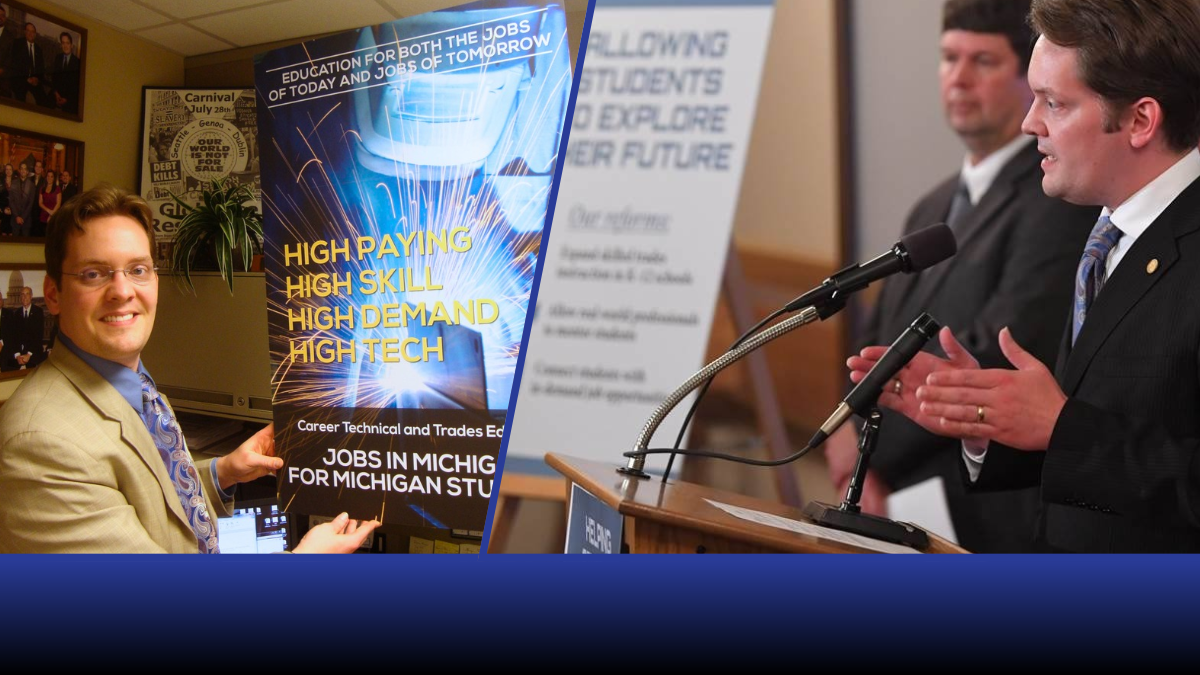
This piece originally ran in Durand Now on May 15, 2026, with the headline, "Ben Frederick Talks College for All."
For former Republican state representative Ben Frederick, the connection between policy, opportunity, and economic growth has never been partisan — it’s personal.
A first-generation college student, Frederick now serves on the board of Michigan College Access Network, a nonprofit dedicated to ensuring that more Michiganders — particularly first-generation students, students of color, and low-income students — can pursue and complete postsecondary education. His journey from a college degree to the Michigan House to nonprofit advocacy on behalf of his hometown hospital reflects a consistent theme: expanding access to opportunity through thoughtful, human-centered policy.
Confronting Barriers and Reframing Success
Frederick’s perspective on college access was shaped long before his time in the state capitol. Early in his career, during his first run for a local school board, he saw peers with skills and potential struggle to find stable employment.
“A lot of my former peers were underemployed,” he recalled. “They had the skills, but because they received them through career-based attainment and not through a traditional degree path, they were often overlooked.”
That reality stood in stark contrast to earlier generations, when stable, well-paying jobs — like those in manufacturing — were readily accessible without a college degree. As those opportunities declined, the need for education and credentials beyond high school became more critical, leaving many without a clear path forward.
He saw similar patterns in his own family’s experience. Frederick often reflects on his father, a man who built a career through hard work but didn’t have access to the kinds of education or credentials that could have created additional opportunities.
“He had the ability to do more,” Frederick said. “But access just wasn’t there in the same way.”
These changes in employment trends informed his work when Frederick started as a legislator in 2016. He elevated the importance of postsecondary attainment — emphasizing that success doesn’t only come from attending a four-year university, but also through community college, certifications, and career-based training.
At the time, barriers were both structural and cultural. People were facing challenges like non-transferable credits and inconsistent recognition of prior experience, sending a discouraging message that their education didn’t matter or didn’t count. For first-generation and adult learners, those signals were disheartening and often derailed their progress.
Frederick recognized the opportunity to address gaps and better align systems around what students and employers actually need.
“There was a need to re-elevate investment in the trades and in certification programs connected to employer-based credentials,” he said. “And to recognize the work that was already happening — especially in our community colleges — to create career pathways for those who wanted something different than a four-year degree.”
These institutions, he noted, often lead the way in meeting students where they are, offering stackable credentials and more accessible entry points into higher education.
At the same time, Frederick believes progress depends on asking hard questions about outcomes.
“Are we achieving what we set out to do?” he questioned. “Are we getting the results we’re striving for?”
Those inquiries gained urgency as Michigan rallied around its Sixty by 30 goal — to have 60% of working-age adults hold a postsecondary credential by 2030.
“Sixty by 30 created a shared understanding that this work matters,” he said. “But it also challenged us to come together, look at what’s working, and build on it.”
For Frederick, that kind of alignment is where policy becomes most effective.
“Policy creates united ideas and a shared motivation,” Frederick said. “And in a state with a historically fragmented higher education system, that unity matters.”
According to Frederick, strong policy paired with data and appropriate funding can push institutions to rethink how they serve students and create more effective pathways to success.
“The first step is identifying a policy that’s backed by good data and combining it with incentives and funding,” he shared. “Only then does the policy turn into a catalyst for change.”
A Bipartisan Approach To Strengthening Our Workforce
During his time as mayor of Owosso and later as a legislative staffer and Republican lawmaker, Frederick was working on the ground in workforce and education policy when he encountered a relatively new organization beginning to shape conversations across the state.
At the time, MCAN was emerging as a central hub for ideas around college and career readiness that brought together local leaders, data, and policy insights in a way that stood out.
“MCAN was showing up in the conversations that mattered, not just with ideas, but with strategy and a real willingness to engage,” he reflected. “They were one of the first to embrace the idea that postsecondary attainment isn’t one-size-fits-all and were never afraid to demand more for Michigan's students.”
As Frederick’s work in the legislature around workforce development and postsecondary attainment expanded, so did his connection to MCAN. He came to see the organization not only as a participant, but as a trusted, nonpartisan resource in education policy.
“MCAN elevates their work beyond partisanship,” Frederick said. “They are a team of problem-solvers, trusted collaborators, and are respected across the political spectrum of lawmakers because of their unwavering commitment to do what’s best for students across the state.”
That reputation proved critical during the development of Michigan Reconnect, a statewide initiative Frederick helped champion to support adult learners as they returned to college. The program, which provides tuition-free pathways for eligible adults, reflects a broader shift in how policymakers think about workforce development and education.
For Frederick, Reconnect represents one of the most meaningful policy wins — not just in expanding access, but in recognizing the realities of balancing education with work and family.
Frederick, who once left college himself before returning to complete his degree, understood the barriers adult learners face.
“As a first-generation student who wasn’t familiar with the campus environment, I struggled with imposter syndrome and feeling like I didn’t belong,” Frederick shared. “Initiatives like Michigan Reconnect help students build confidence and see firsthand how completing a single credit can build into a degree.”
Frederick also sees a direct line between college access and Michigan’s economic future.
“If you can translate your skills to something that’s understood by a wide sector of the economy, you have a tremendous opportunity,” he said. “Credentials and degrees don’t just open doors for individuals; they help stabilize the workforce. In a state that has faced population decline and talent loss, expanding postsecondary attainment is key to reversing those trends.”
The most powerful moments for Frederick come when he can witness the impacts of policy. He recalls meeting adult learners who returned to school through Michigan Reconnect and later approached him to share how it changed their lives and opened doors to new careers.
“You don’t always get to see the outcome of policy you helped shape,” he said. “So when someone comes up to you and says, ‘Because of this, I’m back in school and on a different path,’ that’s incredibly meaningful.
Looking Beyond and Building Common Ground
Michigan’s Sixty by 30 goal has helped focus statewide efforts. But Frederick is already thinking about what comes next.
“What happens when we get there? What will be our next definition of success?” he questioned. “Future policy should dig deeper and examine a combination of attainment rates, wages, career mobility, and long-term stability.”
He also sees an opportunity for Michigan to continue serving as a “laboratory for innovation,” encouraging new approaches like reverse transfer agreements, stronger partnerships between two- and four-year institutions, and expanded outreach to adult learners who may not yet see education as an option.
At a time when political divisions often dominate public discourse, Frederick’s work offers a different model — one where shared goals, data, and collaboration drive progress.
“I think it’s important to set aside preconceived ideas,” he said. “Policymakers should continue to strive to engage with institutions, find out what’s happening on college campuses, and really open their eyes to how much policy can support.”
For MCAN, that means continuing to serve as a connector, a catalyst, and a trusted voice in policy conversations, bringing together educators, employers, and lawmakers to expand opportunity for all students.
And for Frederick, it means staying focused on what matters most: ensuring that every Michigander, regardless of background, has a clear and achievable path to success beyond high school.
“Postsecondary attainment for all,” he said. “That’s the mission, and it’s one worth working toward together.”
ABOUT BEN FREDERICK
Ben Frederick was born and raised in Owosso, Michigan. He worked for over 14 years in both the Michigan House and Senate as a legislative staff member. Frederick was also elected to the Owosso City Council, serving three terms as the community’s youngest mayor. He then served as state representative for three terms, serving his final term as the House Majority Floor Leader. He presently serves as Associate Vice President for Advocacy and Government Relations at Memorial Healthcare, an independent hospital in Owosso. Frederick is a first-generation college graduate and holds a B.S. in interdisciplinary studies from Liberty University and an M.S. in management and leadership from Western Governors University.